
ON THE COLD IN THE COAL CITY
Osinachi K. Ezema
The Coal City is cold.
It is cold with anxiety.
Political anxiety.
The tension—far too loud to be hidden in the shadows of covert silence—remains unspoken. But that, indeed, is the substance of all tensions, and of this one about which I speak.
There is a sense in which I find myself compelled not only to understand but also to appreciate His Excellency, Dr Peter Ndubuisi Mbah’s approach to governance. For a long time, I have held the view that it is either we confront real governance and downplay party politics in this country, or we continue to treasure the stupendous emptiness of party politics at the disastrous expense of good governance.
I hold this principle as an unshaken value of my own conscience as a political leader in training.
Yet I concede that the real task of leadership lies in finding a balance where neither governance nor politics consumes the other, for both are essential to the progress of society.
Let us admit that this balance is rare—a rare psycho-political mineral. It is my hope that the outcome of my training, like that of many others of similar conviction and ambition, brings me closer to it.
In the Southeast, Governor Alex Otti readily comes to mind as an embodiment of this balance.
Whether this reflects an ingrained habit formed during his leadership training, or merely the peculiar circumstances of his emergence as the most material figure of the truncated popular aspirations of the 2023 General Elections, I am not yet certain. Nor is my conclusion absolute that other governors within the region—indeed within what once constituted the Biafran state prior to balkanization—are largely masters of political cosmetics. Many appear lost to unprincipled ambitions for second terms and post-governorship cover; others are disempowered by unredeeming oaths of submission to predecessorial bondage, or distracted by the desire to break free from paranoid overlords.
Politics aside, my undeniable bias for Governor Peter Ndubuisi Mbah lies in his apparent addiction to working with quality, highly educated, and experienced minds. With the exception of his local government chairpersons, his appointees are largely world-class.
I struggle to find a parallel elsewhere in the country. This is commendable for administrative efficiency. As for the local government chairpersons, I wish them well. Their limitations are neither personal nor prayer-related, but reflective of a national pattern: despite constitutional autonomy, they are rarely expected to be productive beyond implementing the governor’s political desires, including returning monthly allocations to the state—only to be reimbursed with generous sums to fund infantile luxuries.
Whether Governor Mbah’s appointees are permitted to deploy their expertise beyond clerical efficiency into substantive governance is another matter. Still, he deserves commendation for disappointing the college and congregation of sycophancy that laid siege to Enugu State for far too long.
But this is not the tension of which I speak, nor the cold that has put the Coal Mistress to bed ahead of a fierce battle.
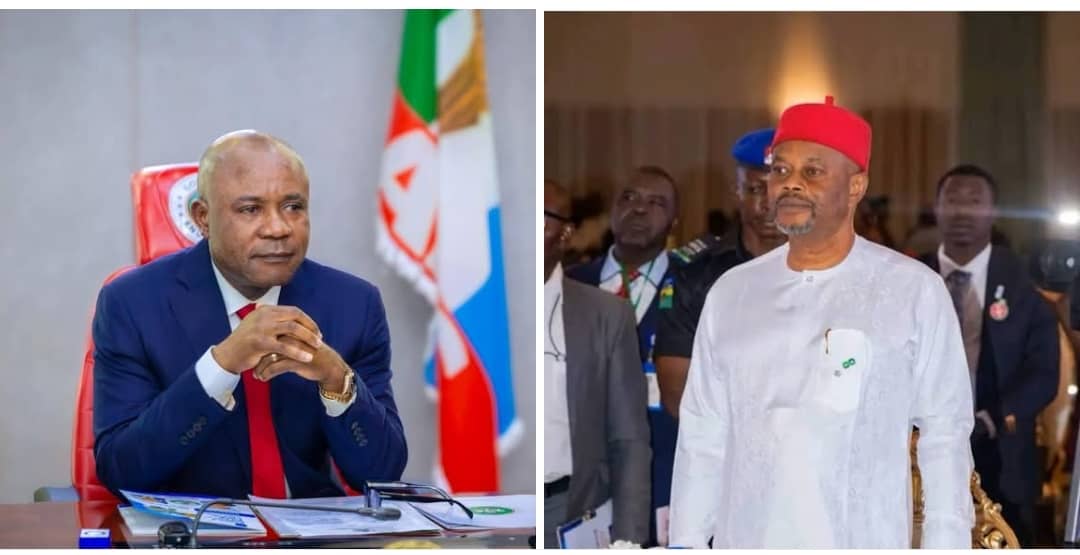
The present political climate suggests that the theatrical victories of 2023 may yet reappear in future elections in Enugu State. Governor Mbah’s switch to the APC—beyond merely plugging the state into the centre—appears calculated to secure institutional assurances in the event of a tight contest arising from coalition politics. One must ask: who would have been the greatest beneficiary of the ADC coalition in the state, and whom the Governor would likely trail in a truly open election? Rt. Hon. Chijioke Edeoga, the Labour Party gubernatorial candidate of the last election.
Edeoga had much to learn from the late Okechukwu Ezea about political patience and disciplined ambition. He learned none. There goes his story. I wish him well. So much, and so brief.
Yet this is still not the tension of the moment. That would be incomplete without the mention of Chief Uche Nnaji, former Minister of Innovation, Science, and Technology.
Take it or leave it: despite the excesses of a few associates who shielded his disciplined generosity from well-meaning stakeholders, and aides who sought to profitt from his gentle innocence, Chief Uche Nnaji nearly transformed himself into a god through sheer simplicity and accessibility. He offered real employment—freely—to men, women, and youths who otherwise could not afford dignity of pay. Reserved, mild, confident, gentle, kind, and action-oriented, he understood the pulse of the people and held it firmly. They understood him, and they loved him for it.
He was a party man who knew how to build a party without suffocating public duty. He built the APC in Enugu State from a cradle of shame and disorientation into a platform of promise and competitiveness.
No one can take this away from him. None.
Had there been even one dissenting associate to persuade him to embrace the militarily displaced factions whose rebellion sought nothing more than accommodation, he might have written a new chapter in Nigerian party politics—one resembling a political family in practice, not rhetoric.
Chief Uche Nnaji’s heart proved too large for the narrow political family he was constrained within. This limitation owed less to his convictions than to the siege imposed by a minority of powerful associates and short-sighted aides who successfully prevented healthy dissent. Need I say it again? Chief Uche Nnaji was a dutiful party man—potentially within the realm of Alex Otti.
Governor Mbah, on the other hand, is anything but a party man. He is an elitist. This is not necessarily condemnable. Indeed, it was a necessary corrective for the PDP in Enugu State, which had grown wild, arrogant, and detached from governance. The party had become a symbol of hopelessness, where rascality, emptiness, and nepotism thrived unchecked. It required the holy punishment of Peter—the adamant rock—to shatter it.
Having fulfilled this historic task and driven the PDP to its effective doom in the state, the Governor soon encountered the souring influence of the former Minister, who naturally inherited the goodwill of abandoned PDP stakeholders and the everyday victims of an increasingly suffocating tax regime.
Make no mistake: I admire Peter’s commitment to duty and his appetite for quality minds. His vision is demanding—perhaps too demanding for an appetite-driven generation. Yet he has much to learn, not only from Otti about balancing visionary governance without punitive taxation, but also about disciplined vision itself.
The burden of the 2023 theatrical victory is heavy, but he need not resemble Sisyphus—pushing visions uphill only for them to roll back unfinished. Cut a vision according to the cloth, and the people will love it—not because it was grand, but because it was promised and fulfilled.
Still, this is not the real tension.
Now, a tip of it.
On one side stands the Governor—armed with state power, party authority, and federal alignment—having effectively neutralized overt opposition. On the other stands the former Minister, out of office yet dangerous, commanding the silent loyalty of party faithful, displaced PDP actors, and the estranged old APC bloc.
The now-united APC, presided over by Governor Mbah, is deeply divided. The danger of annihilating opposition is that the sole surviving party must absorb every interest. This breeds anger among unaccommodated factions with no legitimate outlet for dissent. They either sabotage from within—as is already evident—or compel the authority to pander to all interests at the expense of governance. That was the PDP’s undoing.
Old APC members now ghost their own party. The Governor, aware of this, has initiated e-registration. Meanwhile, displaced PDP actors quietly nurse dreams of electoral disgrace for the Governor. Yet they fear that federal alignment may render resistance futile. Their anger runs so deep that failure in sabotage feels preferable to success in pretence.
The masses—suffocated by elitism and taxation—are poised to recreate 2023. But no one monopolizes such recreations. The Governor has plugged into the centre, and a whisper hangs in the dark ahead: the ballot or the bullet.
If defeat ever comes in 2027, will it arise from popular revolt and abandoned stakeholders, or from tremors at the centre—now pressured by external oversight and coalition politics? The true peak of tension would be the former Minister’s entry into such a coalition. Tsunami.
Delays surrounding his unresolved certificate saga remain a constraint. The Governor rides incumbency; the former Minister flies on popular affection, anger, and disenchantment. Dangerous—yes. Curable—also yes.
Yet this is still not the deepest tension.
The real tension lies with the people: political retailers rendered rudderless, uncertain, torn between outward compliance and inward loyalty to abandoned structures. Two souls inhabit one body—impatient, angry, undecided. This liminal existence erodes mental and civic stability.
As for the everyday people—the targets and the consumed—their reality is stark: survival without belief, calculation instead of hope, endurance instead of expectation.
When a society arrives here, democracy does not collapse loudly; it erodes quietly.
This is the cold in Coal City.
What the Governor does with the replacement of the late Senator Okechukwu Ezea of Enugu North will either bridge the distance between elitist governance and mass appeal—or deepen the harmattan.


Leave a Reply